The third learner: software defines the cell, the floor completes it
In my last post, I shared a game framework for robot programs. The game had two learners. The person learned to build the game. The computer learned to play it.
This post adds a third learner: the floor team.
Here is my insight on how to work with software defined automation for robot cells.
Software can define a robot cell. Only the floor team can meaningfully complete that definition. When the floor team, the developer, the AI and the digital twin work in one loop, the loop learns things that each member alone cannot learn. This ability comes from many iterations. One long chain of thought of AI reasoning cannot cut it.
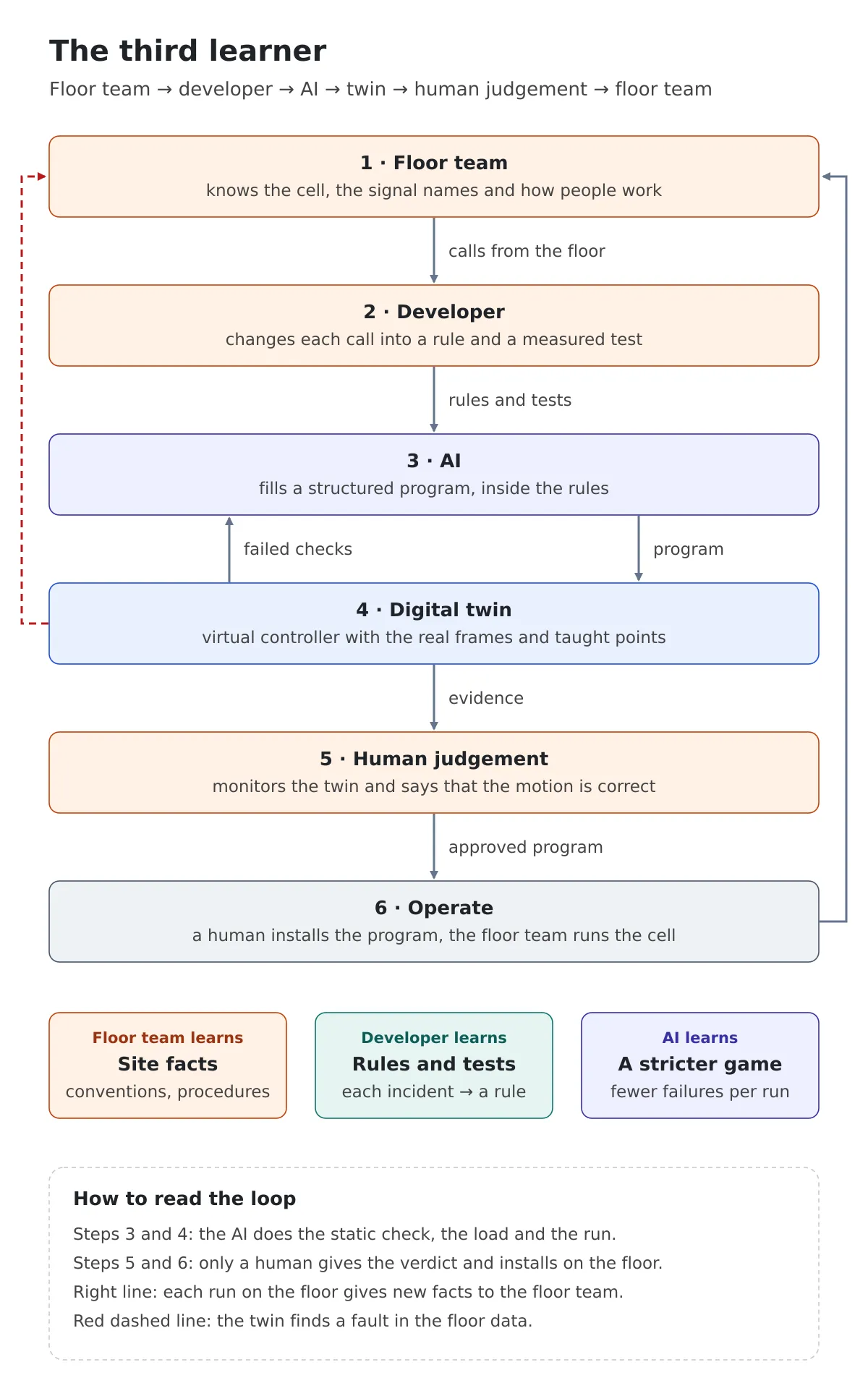
The evidence comes from one robot cell and a few versions of its program. As before, I did the work with an AI coding agent. This time, the rules of the game were set by me and by my experienced shop floor team.
Two announcements, one direction
As I write this, my colleagues are attending Rockwell Automation Fair 2026. A recurring message is that of software-defined automation. The idea is to separate the control software from the hardware that it influences [1]. Then the hope is that the control software can change at the speed provided by the latest AI tools. A digital twin tests the design before the machine gets it. Rockwell also showed a platform where a user describes a result. AI agents then plan the work, do the work and test it [2, 3].
In August, Anthropic opened a research preview of the Model Hardware Standard (MHS) [4]. MHS is a common driver layer for physical devices. Each device gets a driver with a small set of read and write commands. The user describes the device in plain language. From that description, the driver makes a reference file. The file tells the agent what the device can measure, what the agent can adjust, and which safety limits apply.
One idea comes from the automation side. The other comes from the AI side. The two directions converge on the same point: an AI agent that does work on a physical artifact.
I think that both ideas are evolving and I also think there are a lot of opportunities to do it in a way that adds value for its users.
Honest disclaimer
Last week, Anthropic released a set of skills for manufacturing teams. The skills make quotes, quality reports and breakdown analyses, and a person approves each result. The launch post has one short sentence that is easy to miss: the product "doesn't operate equipment" [5]. For equipment, the post points to MHS. And the MHS post says that the physical reasoning of the model has limits, and that an expert oversight is needed [4].
I like the honesty in that disclaimer. It also gives a question to each plant that reads these announcements:
How do you operate equipment with AI?
The third learner is my answer. But first I must show where the floor came into the work.
The layer I made by hand
I have not used MHS. But for one family of industrial robots, I made a layer by hand, and it has the same shape.
| Part of the layer | What it does in my work |
|---|---|
| Unit commands | The AI does not write program text. It fills a structured form. |
| Reference | A set of rules made from the equipment capability and physics involved. |
| Code | AI changes the form into the final program text. It does not guess or generate. It orchestrates. |
| Referee | The virtual controller of the robot. It loads, links and runs each program on a simulated robot. This can be open or closed source. |
This layer was ready in a few weeks. The first programs ran on the virtual controller flawlessly.
Two clocks
There are two clocks in this work.
The first clock measures integration. It stops when the AI sends its first correct command to the machine. Standards and software-defined design make this clock fast.
The second clock measures commissioning. It stops when the cell does the correct job, safely, with people near it. This clock moves only when a person goes to the floor.
The cell in this post is a palletizing cell. One robot serves two lines. It picks boxes from conveyors and puts them on pallets. It also puts a sheet between layers. A PLC controls the conveyors and the pallets. The program iteration is not just AI working in a pc or cloud, it refers to a came version that comes after a successful run by the floor team as depicted in the image above.
What the floor knows
Each visit gave us facts. They were in the habits and the tools of the floor. The reference, the program and the twin did not contain them. I put them in three groups.
1. The points and the trajectory. The roboticist taught the reference frame of each pick station on the pin of a jig. The pin is above the belt. They taught the pick points with the gripper on the belt. Each decision is sensible. But the program used a different convention, with a reference box below the gripper.
On the twin, all checks passed, because the twin had the same convention as the program. On the floor, the robot went down too far and at a wrong coordinate. It is better to leave spatial correctness to the human being.
2. What the names mean. One output had "place completed" in its name. For the PLC, it meant that the full pallet was complete. The vacuum valves for the boxes use inverted logic: a signal that is ON means that the suction is off. The valve for the sheets uses the opposite logic. One data channel had "offset" in its name, but the PLC sent the length of the pallet on it.
A name is a promise from the person who wrote it. Only that person, or the floor, can tell you if the promise is still true.
It is important to follow the language semantics of the operator, AI should know this.
3. How people work. An operator started a service routine with a shortcut on the pendant. The routine then ran in a loop and filled the pendant with messages. Our own monitor read data from the controller too frequently, and the floor team saw that the controller became slow and reported back to the loop.
Each constructive feedback from the floor team became a new rule or a new check.
The twin starts to answer
After the second floor run, I changed the source of the twin. I stopped building it from my design. I built it from the floor controller, in combination with the Twin. The twin now had the real frames, the real taught points, all the tricks from the floor as well as the AI wisdom of the first run.
Then the direction of learning changed. The twin showed that one lift in the sheet sequence was out of reach, by a very small distance. The version on the floor had the same fault. It is a dexterity and path planning issue.
The AI did not change the program to hide the problem. Two rules were already there: do not move a taught point, and do not decrease a safety clearance in the code. The correct action was physical. A person must clear these before running the robot and change the path of the robot to avoid dexterity issue.
The MHS post says the same thing about laboratory work. Some errors are physical failures, and they need physical corrections [4].
The calls from the floor
After the second last run, the ground team sent a list of changes. They wrote it in the language of the floor. Some examples:
- Go to a safe height after each pick and each place.
- Wait above the conveyor. Then go straight to the pick when the box is ready.
- Tell the PLC what the robot is waiting for.
- Do not go down to a pallet that is not there.
- Do not make the cycle slower.
The list was in floor language. The loop changed it into a specification, one sentence at a time:
- The developer and the AI changed each sentence into a condition that a machine can measure.
- The AI wrote the change as a structured program, and the static checks ran.
- The twin ran the cell with a simulated PLC. Each condition got a result with its evidence.
- Where a result needs eyes, hands or the real floor, that part stays open for a person.
All items in the list passed on the twin. Some items have a part that only a person can close. A person must see that the motion is smooth. An operator must try a routine on the pendant. Only the real sensors can give real signals.
What the loop can do
Now I can come back to the claim. These are the things that engineering teams can do today:
- A sentence from a technician becomes a measured test in one or two days.
- A program gets a judgment on a twin that has the spatial awareness of the physical apparatus.
- The twin finds a fault in the floor data and sends a person to measure it.
- The robot tells the PLC its state, its fault and the signal that it is waiting for. Thus the floor team can find the cause of a stop.
- The AI works inside rules that came from human insight and knowhow. It does not change taught points. A person makes each change on the real controller. The AI asks before each connection to the real controller.
Now ask where each ability came from.
- The floor team knows the cell. They do not write the program or the tests.
- The developer writes the rules, but does not know how the points are taught.
- The AI can reason for a long time and perform program synthesis.
- The twin is exact in less iterations than traditional approach.
Each ability came from a specific iteration: a floor run, a finding, a rule, a check and a new run. This is the emergent behaviour. It belongs to the loop, and it became visible only across versions.
It is also the reason for the name "third learner". The floor teaches, and the floor also learns. The PLC team got a list of signals to change. The operators got a different procedure to start the service routines.
How to operate robotic equipment with AI
This is my answer to the open question. In this cell, the AI assists in the operation of the equipment in steps, and each step has an owner.
- Static check. The program agrees with the rules. The AI does this step.
- Load. The virtual controller accepts the program. The AI does this step.
- Digital Run. The program runs on the twin without errors, and the measured conditions pass. The AI does this step after a person approves the runs.
- Verdict. A person monitors the twin and says that the motion is correct. Only a human does this step.
- Operate. A human installs the program on the real controller. Then the floor team runs it. Only an experienced team does this step.
On the real controller, the AI only reads if debugging is required. It reads only after a person permits it at that moment.
Software agents usually work in a different way. A test fails, the agent corrects the code, and the test runs again in seconds. A failed test does not break physical objects. In a robot cell, a failed test on the floor can damage a gripper, a product or poses a safety risk. Floor time is also limited.
Thus the loop must do most of its failures on the twin. And the twin must become more like the floor after each iteration on the floor. That is the work of the third learner. This is also an example of building the game that matters.
So the AI does operate equipment, in a specific way: through a twin, within the rules set by the shop floor team.
Back to the claim
I made three statements at the start.
- Software can define a robot cell. The layer, the twin and the checks show this.
- Only the floor can complete that definition. The taught points, the names and the preferences of experienced roboticists show this.
- The loop learns what its members cannot learn alone. The calls from the floor, and what the loop made from them, show this.
The claims above are about the connection between AI, machines and people that operate them. The connection is necessary. The knowledge of the domain decides what is allowed on the real robot.
Now that software has begun to define the industrial automation, it is only natural that the domain expertise can complete it. It is a fascinating time for automation engineers who can start thinking about encapsulating the domain knowledge into language understood by AI models. As Sean Dotson puts it in his recent blog, "every agent on earth now needs something to call".
How to do it for robotics, and should we call it 'Model Robotics Standard'? Well, that seems fit for another blog!
References
- Rockwell Automation, Software-Defined Automation.
- Rockwell Automation, Rockwell Automation Introduces FactoryTalk Conductor, an AI-Native Orchestration Platform for Industrial Automation, 21 October 2026.
- J. Montague, PSUG focuses on the future of AI, SDA, APL autonomous operations, Control Global, November 2026.
- Anthropic, Previewing the Model Hardware Standard, 27 August 2026.
- Anthropic, Introducing Claude for Manufacturing, 12 November 2026.
- H. Oza, Building the game: iterative learning for deterministic robot programs.